

Warehouse Ceiling Fans Supplier: How to Choose Reliable Industrial Ventilation Solutions
2026-10-19
Warehouse heat isn’t just uncomfortable—it’s expensive. High temperatures slow workers down, warp stored goods, and push HVAC costs sky-high. But picking the wrong ceiling fan supplier can make things worse, with flimsy motors and weak airflow that barely stir the air. Here’s how to spot truly reliable industrial ventilation, and why VINDUSFAN keeps showing up in demanding warehouses.
First, Map Your Warehouse Airflow Before Buying a Single Fan
Walking the floor with a notepad beats any guesswork. Start at the dock doors and follow the path of pallets, people, and forklifts. Where does air already move? Where does it stall? Mark the corners that get stuffy by mid-shift, the aisles where fumes linger, and the mezzanine levels that trap heat. You’re not looking for perfection—just an honest sketch of how air behaves when nobody’s forcing it around.
Once you’ve got that rough map, think about seasonal swings and daily rhythms. A loading bay that breathes fine in March might turn into a dead pocket in July. Cross-draft from open doors can fight a fan you place in the wrong spot. Jot down ceiling height, rack layout, and any columns that break the space. Those details matter more than blade diameter or horsepower. The right fan in the wrong position is just an expensive noise maker.
Know the Difference Between HVLS and High-Speed Fans—Your Ceiling Height Decides
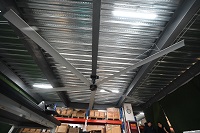
A lot of people assume bigger blades always mean better airflow, but that's only part of the story. HVLS fans move a massive volume of air at a low speed, creating a gentle, floor-wide breeze. High-speed fans, on the other hand, push a focused stream of air quickly, which works wonders for spot cooling. The real question isn't which one is stronger—it's whether your ceiling is high enough to let an HVLS fan do its job without turning the space into a wind tunnel.
If your ceiling sits below roughly 12 feet, a high-speed fan is usually the safer and more practical choice. Mount an HVLS fan too low and you'll feel like you're standing under a helicopter, plus the air gets pushed straight down instead of spreading out. For ceilings above 15 or 20 feet—think warehouses, gymnasiums, or open-plan offices—HVLS fans shine. They slowly circulate warm air down in winter and create evaporative cooling in summer, often replacing several smaller high-speed units.
So before you get swayed by blade size or motor specs, grab a tape measure. Ceiling height dictates not only comfort but also energy efficiency and noise levels. A mismatched fan won't just underperform—it'll annoy everyone underneath it. Match the fan to the room's vertical space, and you'll feel the difference without thinking about it.
Look Beyond the Spec Sheet: What a Supplier's Past Projects Reveal
A datasheet tells you what a component can do under ideal conditions, but it stays silent on how the supplier reacts when conditions shift. Past projects fill that gap. A supplier that has repeatedly delivered into humid coastal environments, for instance, knows which surface treatments actually hold up, regardless of what the corrosion resistance numbers suggest. Dig through their completed work and look for the small details: cable management in tight panels, labeling consistency, the way they handled last-minute changes. Those are the fingerprints of a team that understands how their parts behave outside the test lab.
Beyond physical performance, a supplier's project history reveals their working rhythm. Did they keep the client informed when a batch was delayed? Were their drawings complete enough that the installer didn't need to improvise? These questions rarely appear in a request for quotation, but they determine whether a project finishes smoothly or turns into a series of urgent phone calls. Ask for references who will speak candidly—not just the polished case studies—and pay attention to how long those clients stayed with the supplier.
Finally, look at the range of past projects, not just the biggest name on the list. A supplier that has moved from small pilot runs to full production shows they can scale without losing quality. A supplier that has worked across different industries brings problem-solving habits that won't show up on a spec sheet. Past work is essentially a real-world audit: it shows whether the numbers on paper translate into decisions you can rely on when the project is already behind schedule and the pressure is on.
Ask These Installation and Maintenance Questions Before You Commit
Before you sign anything or hand over a deposit, dig into the specifics of how the product gets installed and what it takes to keep it running. Too many buyers only discover after the fact that a “simple” installation requires structural changes, extra wiring, or a specialized crew. Ask the seller to walk you through a typical install from start to finish, including any hidden costs like permits, disposal of old equipment, or reinforcement materials. If the answer sounds vague or overly optimistic, ask for a written breakdown. A reputable provider will be able to tell you exactly what your space needs and why.
Maintenance is where a lot of attractive upfront prices quietly turn into long-term headaches. Find out who is responsible for routine upkeep, how often it’s needed, and whether replacement parts are easy to source. Request the manufacturer’s recommended service schedule and compare it with the seller’s claims. If they insist the product is “maintenance-free,” ask what happens in year three or five when seals wear out or sensors drift. A straight answer about wear-and-tear costs now can save you from an expensive service contract later.
Finally, ask about real-world failure rates and the process for getting help when something goes wrong. Does the installer have a local service team, or will you be stuck on hold with a call center? What’s the typical response time for a non-emergency issue, and is there a loaner or temporary fix while parts are on order? The goal isn’t to assume the worst—it’s to confirm that the company has a plan for keeping your installation functional long after the invoice is paid. If they can’t answer these questions clearly before you commit, that silence should tell you everything.
Calculate True Lifetime Cost, Not Just the Price Tag
A tempting price tag can hide a mountain of future expenses. When comparing options, look beyond the initial purchase and add up everything you'll pay over the years you expect to own the item. This includes energy or fuel consumption, routine maintenance, replacement parts, and even potential repair costs that crop up as the product ages. A cheaper model that guzzles electricity or needs frequent servicing can easily end up costing more than a pricier, well-built alternative.
Resale value also plays a quiet but powerful role in lifetime cost. Two items might cost the same upfront, yet one retains far more of its worth when you decide to sell or trade it in. Depreciation is a real expense, even if it doesn't show up on your monthly bill. Checking typical resale prices for similar used models can reveal which option truly holds its value.
Finally, consider the cost of downtime and inconvenience. If a product fails often or is difficult to repair, the lost time and hassle carry a real cost. A dependable item that lasts longer without headaches isn't just more pleasant to own—it's often the smarter financial choice when you view the full picture.
Test with a Pilot Zone: Why One Fan Can Prevent a Costly Mistake
Setting up a pilot zone before full-scale production sounds like extra work, but it often reveals failures that would otherwise slip through. Consider a simple cooling fan intended for a new line of industrial controllers. In the controlled chaos of a pilot run, the fan’s bearing started whining after only forty hours of continuous use—well short of the expected lifespan. That single observation led the team to swap in a different supplier and tweak the mounting bracket, avoiding what could have been a recall affecting thousands of units.
The fan itself wasn’t the star of the show; it was the decision to test in a limited, real-world environment before committing to mass production. Pilot zones create a safe space for components to fail early, when fixes are cheap and the lessons are still fresh. One overlooked fan can cause overheating, downtime, or even fire risks downstream. By catching it in a small batch, the company saved the engineering hours and warranty claims that would have piled up later. That’s the quiet power of a pilot zone—it turns a ten-dollar part into a guardian against a six-figure mistake.
FAQ
Focus on their track record with similar industrial projects, the quality of materials used in motor housings and blades, and whether they offer on-site airflow assessments rather than just selling a product. A dependable supplier will also have clear warranty terms and local service support.
Not necessarily. The ideal size depends on ceiling height, aisle layout, and heat sources. A fan that is too large can create uncomfortable drafts in work zones, while undersized fans leave stagnant pockets. Ask for a computational fluid dynamics report or a site survey before committing.
Look beyond the wattage label. Check the motor type—direct drive permanent magnet motors tend to use less power at lower speeds than gear-driven models. Also compare airflow per watt, usually listed as CFM per watt, and confirm the fan has variable speed controls so it can run at partial load instead of full blast.
Mounting on steel beams, ensuring adequate clearance from sprinklers and lighting, and routing power without interfering with overhead cranes are common hurdles. A qualified supplier should provide structural mounting kits and coordinate with your facility team before installation day.
Moisture and particulate buildup can corrode standard motors or unbalance blades over time. Reliable solutions use sealed bearings, corrosion-resistant coatings on exposed metal parts, and blade designs that shed dust instead of collecting it. Ask about IP ratings and whether the fan is rated for washdown or dusty conditions.
In many cases yes, especially in open floor plans with high ceilings. A single large-diameter fan can move air more uniformly and use less total energy than a cluster of smaller units. However, if you have partitioned areas or dense racking, you may still need supplementary fans for targeted airflow.
At minimum, schedule blade cleaning, check motor mount torque, inspect safety cables, and verify control panel connections every six months. For high-use facilities, quarterly inspections are better. The supplier should offer a maintenance checklist specific to your model rather than a generic one-size-fits-all sheet.
Conclusion
Choosing a reliable ceiling fan supplier for a warehouse starts long before you look at pricing. A careful walk-through of your space to map airflow patterns—where heat builds up, where dock doors open, where employees work—will shape every other decision. From there, ceiling height really drives the fan type: high-volume, low-speed (HVLS) units shine in buildings with clearance above 20 feet, while high-speed fans often make more sense in lower bays or spot-cooling zones. Don't let a polished spec sheet be the only thing you evaluate. Dig into a supplier's previous installations, especially in warehouses similar to yours, and ask for references who can speak to how the fans performed through summer peaks and winter stratification. Installation and maintenance questions should be direct: who handles the mounting, what clearance is needed from sprinklers and lighting, how often do belts or bearings need attention, and what does emergency service look like?
A cheap upfront price can hide years of higher energy bills and frequent repairs, so calculate the lifetime cost including motor efficiency, expected lifespan, and parts availability. If you're still unsure, run a pilot in one section of the warehouse before committing to a full rollout—one fan can reveal issues with airflow, noise, or structural mounting that no brochure will show. The best suppliers treat this as a partnership, helping you interpret results and adjust the plan rather than pushing a one-size-fits-all package. In the end, a reliable ventilation solution comes from matching the hardware to your building's real conditions, verifying supplier claims through past work, and making sure you're not left alone after the installation.
Contact Us
Contact Person: Michael Danielsson
Email: [email protected]
Tel/WhatsApp: +1 951 565 7769
Website: https://www.vindusfans.com