

Rubber Open End Timing Belt Price Factors That Influence Your Total Cost
2026-11-27
When you start comparing rubber open end timing belts, the sticker price is only part of the story. Material grade, tensile cord construction, tooth profile precision, and even how a supplier handles bulk cutting can quietly shift your total cost. At Sanxing, we often see buyers focus on the upfront number while overlooking factors that decide whether a belt runs reliably or becomes a recurring maintenance headache. This post breaks down what actually drives your final spend, so you can avoid overpaying for hidden weaknesses or under-buying for demanding applications.
Raw Rubber and Reinforcement Set the Starting Point
Before any tread pattern is cut or sidewall stamped, a tire begins with two deceptively simple inputs: raw rubber and reinforcement. The rubber compounds arrive as bales, strips, or pellets, but their final behavior depends on how fillers, oils, and curing agents are dispersed through the polymer. That mixing stage sets hardness, tear resistance, and heat buildup long before the tire sees a road.
Reinforcement carries the load that rubber alone cannot. Steel cord, polyester, nylon, or aramid is calendered into thin rubber sheets at precise tensions and spacing. If the cord angle or gauge drifts, the cured tire may pull, wear unevenly, or fail under pressure. In this sense, the tire’s character is largely fixed at the calender and the mixer, not just in the mold.
From there, these materials move into component cutters and building drums, but the practical limits are already established. Adjusting a compound’s modulus or a reinforcement’s elongation changes how the finished tire steers, rides, and survives high-speed heat cycles. Getting this starting point wrong is difficult to correct downstream, which is why process control at raw material intake and mixing remains the quiet foundation of every reliable tire.
Belt Width, Length, and Tooth Profile Shift the Unit Cost
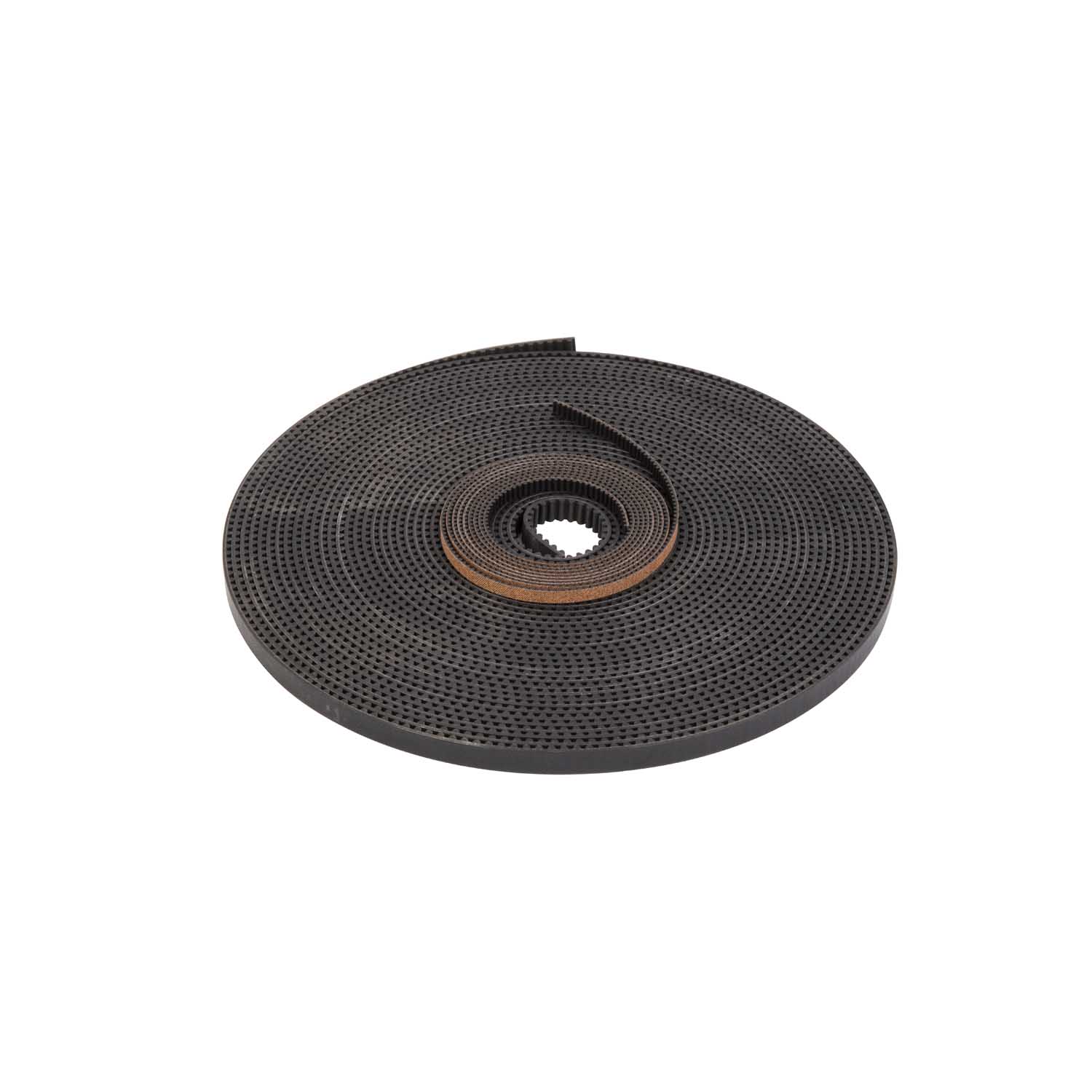
Wider belts rarely cost as much as the raw material math suggests at first glance. Tooling, slitting setup, and minimum order quantities often hit small-volume buyers harder than the added polyurethane or rubber itself. Once a line is set up for a nonstandard width, the waste strip left at the edge can turn what looks like a modest material upcharge into a real jump in the final part price.
Length drives unit cost through yields, not just meters of stock. A belt cut slightly off-standard may force the fabricator to nest parts in a way that leaves a long unusable remnant, and that remnant is still paid for. Tooth profile adds another layer: simpler trapezoidal profiles run faster and with less tool wear, while modified curvilinear or specialty pitches can require slower molding cycles, dedicated tooling, or secondary trimming. Those demands show up as a higher cost per tooth, especially when tolerances are tight.
Custom Tooling Is a One-Time Expense With Long Lead Times
Custom tooling is often budgeted as a single line item, but that line casts a long shadow. The upfront cost covers design, material selection, machining, and trial runs, and it will not repeat unless a redesign or excessive wear forces a replacement. That makes the initial quote feel heavy, especially when compared with off-the-shelf components whose costs are spread across many buyers.
Lead times are where schedules tend to slip. A custom fixture or die may sit in engineering review for weeks before the first cut is made, then move through several rounds of adjustment before it is approved for production. If the part has tight tolerances or calls for an unusual alloy, expect the timeline to stretch further. Waiting until the product design is fully frozen before ordering the tooling usually pushes the launch date back more than most teams anticipate.
The practical move is to treat custom tooling as a capital decision rather than a routine purchasing task. Lock the design early, allow buffer weeks for first-article inspection, and build the tooling lead time into the project plan from the start. The one-time expense is much easier to justify when the delivery date does not depend on a best-case scenario.
Tolerance Class and Inspection Work Add Up Quietly
Tight tolerance callouts often look simple on a drawing until the inspector starts stacking fixture checks, surface finish verification, and dimensional reports against them. A ±0.005 inch hole pattern does not demand the same handling as a ±0.001 inch bore, but both quietly pull time from the same schedule. The work multiplies when parts sit at the edge of acceptable range and need repeated passes to confirm stability.
Inspection records show the pattern clearly: a few extra checks per feature become dozens across a batch. Different tolerance classes change the measuring tools, ambient temperature assumptions, and frequency of sampling. What starts as a routine first-article layout can turn into hours of rechecking because one dimension drifts closer to the limit than anyone expected.
The real cost rarely announces itself. It accumulates in fixture recalibration, gauge R&R studies, and the back-and-forth between machining and quality when a borderline reading appears. Shops that treat tolerance class as part of the quote instead of an afterthought usually catch the hidden hours before they settle into a job.
Order Quantity Changes the Price More Than Most Buyers Expect
A unit price is rarely just the cost of materials plus labor. When a factory quotes 100 pieces and then quotes 1,000 pieces, the drop in per-unit cost often surprises buyers because it has little to do with the product itself. Setup time, machine warm-up, material minimums, and packaging adjustments stay nearly constant whether the run is short or long. Spread those fixed tasks over a few hundred extra units and the math changes quickly.
The biggest shifts usually happen at specific volume breakpoints rather than gradually across the board. A factory might handle 300 units with semi-manual finishing but switch to automated cutting at 1,200 units. That one change can lower the unit price by 25 to 40 percent, yet the quote for 1,100 units may still sit at the higher tier. Asking for a small ladder of quantities, not just one target number, reveals where those jumps occur.
Larger orders can also stop making things cheaper. Once a production line is nearly full, a big order may force overtime, disrupt other runs, or require faster raw material deliveries. Some suppliers will quote a higher unit price for that risk, which confuses buyers who expected volume to always mean a discount. The practical move is to compare several quantity bands and see whether a modest increase in order size pulls you into a much better cost structure.
Shipping Distance and Packaging Can Outweigh the Product Cost
A low sticker price can quietly disappear under freight charges once distance and handling enter the picture. A box of brackets that costs a few dollars from a supplier two states away may arrive with a shipping bill three times that amount, especially when the item is heavy enough to cross into dimensional weight territory. The product itself was never the expensive part; moving it was.
Packaging adds another layer that rarely shows up on the product page. Fragile or oddly shaped goods often demand reinforced cartons, foam inserts, corner protectors, and extra tape before a carrier will accept them. These materials and the labor to apply them can easily surpass the cost of the item inside, which turns a bargain into a break-even purchase or worse.
The practical takeaway is to compare landed cost rather than unit price. Two suppliers may list the same part at very different prices, but the cheaper one located farther away can end up costing more after packaging surcharges and long-haul freight are added. In those cases, the real saving comes from shorter distance, simpler packaging, or ordering enough volume to spread the cost across many units.
FAQ
The internal tensile cord and rubber compound usually move the needle more than anything else. A belt built with high-grade neoprene or HNBR and aramid or steel cord will cost noticeably more, but it also handles heat, oil and sustained load better than a basic rubber body with fiberglass reinforcement.
Yes, width tends to affect cost faster than length because it increases material usage across the entire roll and often requires wider tooling or a different production setup. A small jump in width can push the price per meter up more than adding a few meters of length.
The differences usually come down to compound quality, cord type, tooth profile accuracy, tolerance control, and whether the supplier is running a standard stock program or cutting a custom size. Cheaper belts often skimp on consistency, which shows up later as premature tooth wear or uneven tension.
Definitely. You may run into cutting or setup fees, minimum order quantities, freight, import duties, testing or certification charges, and the cost of holding inventory. If a belt fails early, unplanned downtime and replacement labor can erase any initial savings.
If the application has high peak loads, frequent starts and stops, wide temperature swings, or tight registration demands, the upgrade usually pays for itself through less stretch and longer service life. For light-duty conveying or simple motion tasks, a standard fiberglass cord is often enough.
In many cases, yes. Open end rolls let you cut to the exact length you need, reduce dead inventory, and avoid setup charges for made-to-order loops. The trade-off is you need a reliable joining method on site, or you still have to order pre-cut lengths with prepared ends.
Non-standard profiles and pitches usually require dedicated tooling or additional machining, so the upfront cost jumps quickly. If a catalog profile like HTD, GT, T, or AT will work, staying with that standard is almost always the cheaper route unless your design truly cannot accommodate it.
Conclusion
Most buyers assume the cost of a rubber open end timing belt is set by the meter, but the actual figure is shaped long before a single tooth is molded. Raw rubber and reinforcement choices such as fiberglass, steel, or aramid establish the baseline because material availability and compounding requirements vary widely. From there, width, length, and tooth profile push the unit price in ways that are easy to overlook: a wider belt consumes more material, and uncommon profiles often require slower production or different curing setups. Where the quote really changes, however, is tooling. If the profile is not already in the supplier's library, custom mold or tooling costs appear once but can stretch lead times and tie up capital before any product ships.
Tolerance class and inspection requirements add another layer that rarely shows up as a line item. Tighter dimensional control demands more frequent measurement, better process discipline, and sometimes secondary finishing, all of which raise cost quietly. Order quantity is equally powerful: short runs lose volume efficiencies, while larger batches may unlock better material pricing and setup amortization. Finally, shipping distance and packaging can outweigh the product cost itself, especially for long, flexible belts that need rigid packaging or oversized freight handling. Rather than comparing belt prices alone, buyers should look at the combined effect of these factors, because a low unit price can quickly become a high total cost once tooling, tolerances, order size, and logistics are included.
Contact Us
Contact Person: Becky
Email: [email protected]
Tel/WhatsApp: 0086-15168665227
Website: https://www.sxbelts.com