

China Swiss CNC Lathe for Precision Small Parts Manufacturing
2026-08-22
Holding ±0.005 mm on a 2 mm stainless steel pin sounds impossible—until you watch a Swiss CNC lathe do it all day. China has become a go-to source for these high-precision turning centers, but "Swiss-type" gets thrown around too loosely. WINNRUI CNC is one builder that puts guide bushing rigidity, tool layout, and thermal stability first—not as optional extras. Here, we’ll separate real Swiss capability from marketing claims.
Why Swiss CNC Lathes Excel at Ultra-Small Part Geometries
The sliding headstock design sets Swiss CNC lathes apart when it comes to micro-scale work. Instead of holding the bar stock in a fixed position and moving the cutting tools along the entire unsupported length, the material itself advances through a guide bushing. This means the tool always cuts just a few millimeters from the bushing face, drastically reducing deflection and chatter even on parts with extreme length-to-diameter ratios. A 0.5 mm diameter shaft that would bow or whip in a conventional lathe stays rigid enough to hold tolerances measured in microns.
Because the workpiece is supported so close to the cutting zone, Swiss machines can take aggressive passes on tiny features without sacrificing surface finish. The guide bushing also enables simultaneous turning, milling, and drilling operations from multiple axes, so you can complete a complex miniature connector or bone screw in one setup. Fewer rechuckings mean fewer opportunities for concentricity drift — a common source of scrap when tiny parts are moved between machines.
Thermal growth, often the hidden enemy in precision machining, is easier to manage on a Swiss lathe thanks to its compact work envelope and the short distance between the spindle and the cutting tools. Combined with high-pressure coolant delivery through the guide bushing area, chips are evacuated instantly, preventing recutting that would dull micro-tools and distort fine geometry. The result is a platform that consistently delivers sub-millimeter features with roundness and straightness that push the limits of what was previously considered machinable.
Inside a Chinese Swiss Machining Shop Where Tolerances Never Sleep
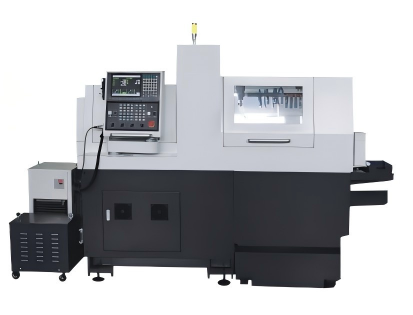
The air inside the shop carries a faint metallic tang, mixed with the steady hiss of cutting oil hitting carbide. Rows of Swiss-type lathes hum in near-silence, their sliding headstocks moving with the kind of repeatability that makes a micron feel like a mile. Here, a 0.005 mm deviation isn't just a rejected part—it's a conversation that stops the line until the root cause is found.
Operators don't just watch screens; they listen. A slight change in spindle pitch, a tiny vibration in the guide bushing, or a coolant temperature drift of half a degree can shift tolerances before any gauge catches it. The shop floor runs on ritual: first-article inspections at 2 a.m., tool wear charts updated every 200 cycles, and climate-controlled metrology rooms where parts sit for hours just to stabilize before measurement.
What sets this place apart isn't the machines themselves—many shops own the same models. It's the refusal to let variation hide. Bar feeders are tuned to within a tenth of a millimeter of runout, cutting tools are swapped before they hit 70% of predicted life, and every batch carries a paper trail that traces back to raw material heat numbers. In this shop, tolerance isn't a spec on a drawing; it's a living habit that never clocks out.
Material Choices for Precision Small Parts That Most Buyers Overlook
When sourcing precision small parts, buyers tend to fixate on dimensional tolerances and surface finish while defaulting to familiar metals like 303 stainless or 6061 aluminum. Yet the material itself often dictates whether those tight specs remain stable over time. For example, stress-relieved grades of brass or beryllium copper can outperform common steel in miniature components that must hold micron-level geometry after exposure to temperature swings or vibration. Ignoring these alternatives leads to parts that pass first article but drift out of spec in the field.
Another overlooked area is engineered polymers and ceramics. PEEK, for instance, offers machinability close to metal with far lower mass and excellent chemical resistance, making it ideal for tiny manifolds or insulators where metal adds unnecessary weight or galvanic risk. Similarly, technical ceramics like zirconia or alumina provide hardness and wear resistance that no coated metal can match at sub-millimeter scales, especially in abrasive fluid or high-cycle contact applications. The real challenge is matching the material's thermal expansion coefficient and microstructural stability to the operating environment, not just the drawing's nominal strength requirements.
Perhaps the biggest blind spot is cost of ownership rather than raw material price. Free-machining alloys may reduce cycle time, but if they require secondary heat treatment or exhibit unpredictable burr formation in micro-drilling, the final part cost rises. Materials like Invar or Kovar, though expensive by the pound, often eliminate costly post-machining stress relief and improve assembly fit with glass or ceramic seals. Buyers who evaluate material choices only on a per-kilogram basis routinely pay more downstream through scrap, rework, and field failures.
Tight Tolerances at High Volume Without the Usual Price Premium
Traditional wisdom says tight tolerances come with a steep cost, especially at scale. But by embedding statistical process control directly into high-speed production lines, every part stays within spec without the usual markup. For instance, maintaining ±0.05 mm dimensional stability across continuous runs costs about the same as a standard-tolerance product.
The key is early investment in smart tooling and automated inspection, which eliminates most manual sorting and scrap. Each batch feeds real-time data back into the process, so drift is corrected before it becomes expensive rework. The result is predictable, consistent output where the price doesn't suddenly jump when tolerances get tighter.
For buyers, this means no forced trade-off between precision and budget. Whether the order is 10,000 or 1,000,000 units, the pricing structure stays transparent and tight tolerances never become hidden surcharges. In practice, customers can drop these parts straight into their assembly lines without extra inspection steps.
From Medical Implants to Watch Components, the Small Parts That Demand Perfection
A pacemaker lead thinner than a strand of spaghetti flexes millions of times without snapping; a tourbillon cage in a luxury watch holds its poise through shocks hundreds of times its own weight. The two parts look nothing alike, yet both live under the same brutal arithmetic—once features shrink below a few millimeters, a two-micron drift can turn a life-saving implant into a liability or silence a mechanical heartbeat.
Shops that survive this work rarely treat 'precision' as a slogan. They argue over burr formation on titanium threads, test how a laser-welded seam behaves during thermal cycling, and drop sapphire watch bearings onto granite blocks just to see if a batch will fail in ways no customer will ever notice. Inspection runs in parallel with machining, not after it: optical comparators and white-light interferometers scan parts while CNCs are still cutting, culling rejects before they reach a human hand.
The real difference is hidden in small refusals. A collet that is slightly softer so it will not mar a polished flank. A batch re-cut because the grain structure looked suspicious under 40x magnification. A part that meets the drawing but gets scrapped anyway because it violates common sense. In an implant, that stubbornness is patient safety. In a watch, it is the gap between a decade of faithful timekeeping and a warranty return. Small parts do not forgive shortcuts.
Sourcing Swiss CNC Machined Parts from China Without the Guesswork
The first step to sourcing Swiss CNC machined parts from China without guesswork is to look beyond glossy websites and generic capability lists. Ask for a detailed breakdown of their Swiss turning equipment, including the number of axes, bar capacity, and whether they run Citizen, Star, or Tsugami machines. A supplier that can tell you exactly which model produced a similar part—and how they held tolerances of ±0.005 mm on a previous job—is far more valuable than one that simply says "we do Swiss machining."
Next, push for a small pilot batch before committing to volume. This isn't about testing if they can make one good part; it's about seeing whether their process is repeatable. Request a first article inspection report with actual measurement data, not just a certificate. If they hesitate to share dimensional reports or material certifications, treat that as a red flag. The best Chinese shops will often over-communicate on quality because they know Western buyers have been burned by guesswork before.
Finally, build your own checklist around the specific geometry you need—deep holes, thin walls, or small diameters under 32 mm. Have them walk you through how they would machine a critical feature, and listen for whether they mention tool wear, chip evacuation, or secondary deburring. A partner who raises potential issues before you do is one you can rely on. That level of proactive thinking removes guesswork more than any audit checklist ever will.
FAQ
The sliding headstock design feeds the bar stock through a guide bushing, which keeps the cutting tool close to the workpiece. That extra support drastically reduces deflection, so you can hold tight tolerances on long, slender parts without chatter.
Many manufacturers in China have invested heavily in temperature-controlled assembly rooms and imported linear guides and spindles from established brands. The result is a machine that can hold ±0.005 mm day after day, though it's still wise to check the specific factory's quality audits and after-sales support.
Typical work includes bone screws, dental implants, watch pins, electronic connectors, fuel injector nozzles, and micro shafts. Essentially anything with a small diameter and a high length-to-diameter ratio benefits from the Swiss approach.
Look beyond the price tag. Compare the spindle runout, rapid traverse rates, maximum main and sub-spindle speeds, number of live tool positions, and the control system. Request a test cut on your actual material and measure the capability index before making a decision.
They use standard Swiss tooling like guide bushings, collets, and gang plates, but the setup philosophy is different from a conventional lathe. Operators need to understand bar feeder alignment and guide bushing clearance, otherwise even a top-tier machine will produce scrap.
Stainless steel, titanium, brass, aluminum, PEEK, and even precious metals like platinum. The key is choosing the right guide bushing and cutting parameters, because some materials work-harden quickly and demand rigid tooling.
They are compact by design. A standard 20 mm capacity machine often fits in about 1.5 m by 1.8 m of floor area, including the bar feeder, which makes them attractive for shops with limited space.
Many exporters now maintain local warehouses in North America and Europe, or partner with regional distributors. Before buying, ask for a list of critical spares, typical lead times, and whether remote diagnostics are included.
Conclusion
Swiss CNC lathes have a structural advantage that conventional turning centers simply cannot match when it comes to ultra-small part geometries. The sliding headstock and guide bushing support the bar stock within millimeters of the cutting tool, which drastically reduces deflection and vibration. For a Chinese shop running 24/7, this means holding diameters of 0.3 mm or smaller with repeatable tolerances in the ±0.005 mm range, even on long, slender parts like bone screws or micro-connectors. The real differentiator is not just the machine itself, but the culture around it. Walk into a well-run Chinese Swiss machining facility and you will see climate-controlled rooms, in-process probing, and tool wear monitoring that only pauses for scheduled maintenance. Materials are another place where buyers leave performance on the table. Beyond 316L and titanium, many Chinese suppliers have deep experience with PEEK, cobalt-chrome, and lead-free brass alloys for miniature gears or implantable components, often at volumes that would strain Western lead times.
What looks like a simple watch stem or a tiny bone plate often carries tolerance stacks that would make a general machine shop walk away. Chinese Swiss shops that specialize in small parts understand this tension between cost and perfection. They run unattended overnight shifts with bar feeders and automatic part collection, so high-volume orders do not come with the usual price premium. However, sourcing without guesswork still requires more than a quote. A reliable partner will share first-article inspection reports, offer material certifications beyond the basics, and be willing to discuss toolpath strategies instead of hiding behind a sales portal. Buyers who take the time to audit a facility or request a trial batch usually end up with parts that rival Swiss or Japanese output, but with a supply chain that is far more responsive. For medical implants, watch components, or micro-fluidic connectors, that combination of tight tolerances, exotic material know-how, and honest communication is what turns a Chinese Swiss CNC supplier from a vendor into an extension of your own engineering team.
Contact Us
Contact Person: Tim
Email: [email protected]
Tel/WhatsApp: +86 15522553731
Website: https://www.winnrui-cnc.com/