

Best Quality Raised Floor Systems for High Performance Workspaces
2026-11-29
When a workspace demands more from its infrastructure, the floor beneath your feet often makes the quiet difference between constant disruption and seamless performance. High-performance environments—think data centers, control rooms, and agile office layouts—need raised floor systems that can handle heavy loads, manage airflow, and adapt without slowing teams down. But not all access flooring is built to the same standard. That’s where Lipin Floor comes in, offering best quality raised floor solutions engineered for reliability and long-term value. In this guide, we’ll break down what separates top-tier systems from the rest, so you can make a confident choice for your next build or retrofit.
Pedestal Design Details That Keep a Raised Floor Level Over Time
Leveling a raised floor isn't a one-time event. It's a slow negotiation between the subfloor, the pedestals, and the loads they carry. The pedestal heads that work best are machined with a broad bearing surface and a locking mechanism that doesn't rely on thread friction alone. When vibration from foot traffic reaches the adjustable stem, a simple jam nut can work loose over months, leaving one corner of a tile sitting a millimeter lower than its neighbor. That's why many long-term installations now use pedestals with a serrated locking ring or a hex-style collar that bites into the stem without requiring excessive torque.
Another overlooked detail is the base plate geometry. A flat, thin steel base concentrates the load on a small area of the subfloor, which can lead to gradual depression in softer substrates like gypsum or aged concrete. Pedestals with a raised dome or ribbed underside distribute the weight more evenly and resist shifting when the floor is cleaned or when heavy equipment rolls across. The rubberized acoustic pad isn't just for sound—it also creates enough friction to keep the pedestal from drifting on smooth slabs, which prevents the tile joints from opening up over time.
Finally, the gap between the pedestal head and the tile edge matters more than it appears. If the head is too narrow, the tile corners can flex under point loads and slowly grind against the steel, producing dust and micro-movement. A head with small anti-slip tabs or a recessed pocket locks the tile in place without adhesive, yet still allows for thermal expansion without the whole floor creeping. Those small design choices are what separate a raised floor that stays perfectly level for a decade from one that starts showing dips and rattles after the first year.
Panel Surfaces That Handle Rolling Loads Without Visible Wear Patterns
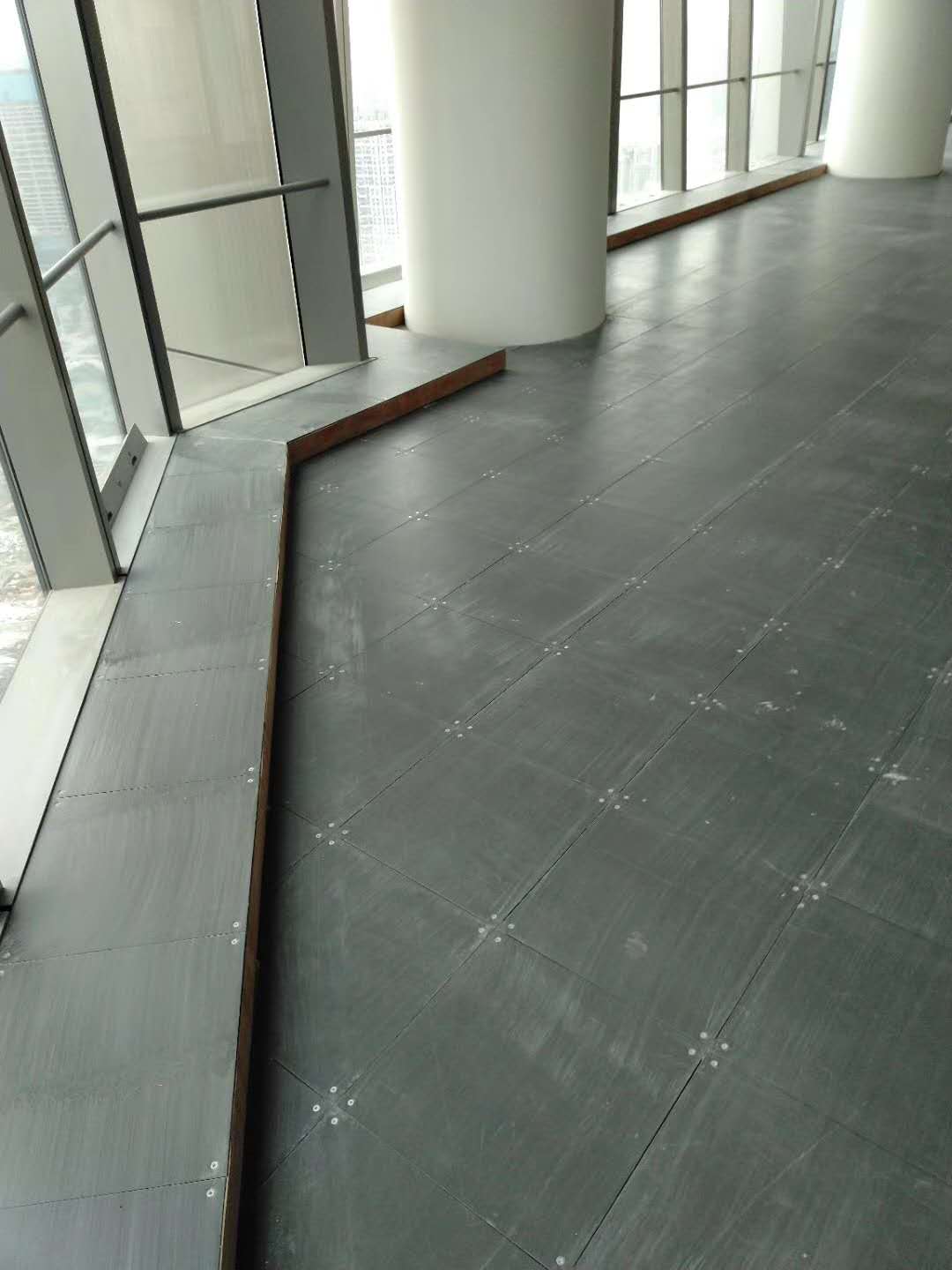
The top layer is formulated around a fine aggregate blend that resists the kind of directional burnishing you normally get from caster wheels and cart traffic. Rather than relying on a clear coat that eventually dulls, the texture and color sit through the entire wear layer, so repeated passes from rolling equipment don't carve out a lighter or shinier traffic lane.
We also keep the surface micro-roughness just below the point where it would collect dirt but high enough to break up the smooth contact patch that causes visible polishing. Under loaded trolley tests, the panels show only a faint, even change across the whole surface instead of the usual track marks that start at doorways and work areas.
Underfloor Air Distribution With Fewer Drafts and Quieter Operation
Comfort often comes down to details you barely notice. This underfloor air system moves conditioned air through a pressurized plenum beneath the floor, releasing it through diffusers positioned close to occupants. Because the air enters the room at floor level and rises naturally with heat, the typical blast of cold air from a ceiling vent disappears. You get a gentle, even spread of temperature without the sudden drafts that make people reach for a sweater or turn up the thermostat.
The same layout that improves comfort also cuts down on noise. Air travels at lower velocity through the plenum and diffusers, so there is less rushing-air sound overhead. Fan and ductwork remain tucked below the floor, away from the occupied zone, which means conversations and focus work are not interrupted by constant mechanical hum. The result is a space that feels calmer, even in open offices or busy conference areas.
Maintenance and rearrangement also benefit from this approach. Floor diffusers can be relocated without altering overhead ducting, letting teams reshape a room without a major HVAC overhaul. Because the system relies on a larger, low-pressure air path, components tend to run with less strain, which supports steadier performance over time. In practice, the room simply holds its temperature more consistently while background noise stays low enough to forget the system is working.
Static Control That Shields Equipment Without Extra Hardware
Most static control methods assume you need to bolt on another layer of protection—mats, wrist straps, ionizing bars, extra grounding cables. But the real shield often comes from the way a machine is already built. Conductive paint on the interior housing, a well-placed drain path through the frame, or even the deliberate choice of roller materials can neutralize charge before it builds into a spark. The equipment itself becomes the guard, not the accessory.
Think of a conveyor line moving plastic trays. Instead of adding blowers or misting nozzles, the design uses a slightly conductive belt compound that leaks charge to grounded side rails at every rotation. The trays never have a chance to accumulate enough voltage to arc into a sensor or adjacent PCB. It’s quiet, invisible, and costs nothing extra on the bill of materials—just a different spec on an existing part.
This approach shifts the conversation from “what can we add?” to “what can we alter?” A steel bearing housing with an anodized coating might be swapped for one with a thin conductive oxide layer. A plastic guard panel gets replaced by a carbon-filled polymer. No new hardware, no maintenance schedule, no extra failure point—just a design choice that handles static as naturally as gravity handles falling objects.
Reconfiguring Workspaces Without Tearing Into the Floor System
Moving a bank of desks no longer has to mean saw-cutting concrete, pulling cable, and waiting for the dust to settle. With a modular underfloor distribution setup, power and data can be routed through pre-wired floor boxes or plug-and-play connection points that sit flush with the finished floor. Furniture can be shifted over a weekend; the existing slab, carpet or tile remains intact, and the only visible change is the new desk layout.
The real advantage shows up when teams shrink, expand, or switch from assigned desks to shared work areas. Instead of scheduling electricians for every move, facility staff simply lift a few access panels, reposition the floor boxes, and reuse the same cables and connectors. It is less about adding infrastructure and more about making the space respond to how people actually work from one quarter to the next.
That flexibility also reduces long-term cost because the floor system is treated as a reusable asset rather than something to be abandoned after each change. Buildings keep their original flooring layers, and tenants avoid the noise, downtime, and patching that usually come with rewiring. For occupants, the result is a quieter transition and a workspace that can be reconfigured without leaving scars behind.
Acoustic Performance That Keeps Open Offices from Sounding Hollow
Open offices often fail not because they are too loud, but because the room itself has no acoustic character. Hard ceilings, glass walls, and polished concrete leave mid-range voices bouncing between parallel surfaces until speech turns into a smeared, metallic wash. That hollow quality is a sign of uncontrolled reflections, not just excess volume.
The fix starts with placing absorption where sound actually gathers. Ceiling baffles and wall panels with a high noise reduction coefficient pull energy out of the 500 Hz to 4000 Hz range before it can build up. Desk screens and felt dividers handle the near-field reflections that make nearby conversations feel intrusive, while taller acoustic pods give teams a place to talk without forcing everyone else to hear the details.
What changes is not silence, but clarity. A well-tuned open office keeps a sense of activity while removing the empty, cavernous edge that makes people raise their voices. The result feels closer to a furnished studio than a gymnasium, and that shift is usually noticeable within the first few minutes of walking through the space.
FAQ
A dependable system should combine stable pedestal support, tight panel seams, predictable load performance, and clean underfloor access. In a high performance workspace the floor also needs to manage air distribution, conceal power and data cabling, and stay easy to open without disturbing nearby workstations.
They create a plenum under the floor that lets conditioned air travel directly to equipment or workstation zones. Perforated or adjustable panels can be placed where heat loads are highest, so cooling is delivered at the source instead of relying only on ceiling ducts.
Steel-encased panels, calcium sulphate cores, and high density woodcore are common choices. The right option depends on load requirements, moisture exposure, and finish preferences. Look for panels with reinforced edges and factory bonded surfaces rather than soft or loosely fitted coverings.
Yes, but you need to match the panel grade and pedestal spacing to the equipment. Manufacturers list concentrated, uniform, rolling, and ultimate load ratings. Rack rows usually require upgraded panels, additional stringers or pedestals, and careful placement near cutouts.
Not really. Finish options include carpet tiles, vinyl, rubber, high pressure laminate, and stone or porcelain surfaces. Many teams mix finishes to define zones and add subtle branding without sacrificing access to the space below.
Edge trim damage, loose pedestals, uneven panel seating, and dust buildup in the plenum are the usual problems. A simple quarterly walkthrough that checks for rocking panels, worn gaskets, and blocked airflow can prevent most performance issues.
That is where they shine. Power, voice, and data can be routed underneath, so reconfiguring desks or teams becomes faster and less disruptive. You avoid cutting concrete or fishing cable through walls every time the space changes.
Because weak panels, poor leveling, and difficult access create ongoing costs in downtime, repairs, and cooling inefficiency. A better system tends to feel more stable, last longer, and make routine moves and maintenance much simpler.
Conclusion
A raised floor earns its place in a demanding workspace long before the furniture arrives. The pedestal assembly matters most: locking adjustments and reinforced base plates keep panels from drifting or developing low spots, even where castored chairs and equipment carts make constant passes. That same daily traffic calls for panel surfaces selected for edge support and wear resistance, so the finish does not show rut lines or dull patches after a few years. Where air moves beneath the floor, the best systems use tight gasketing and well-placed outlets to avoid chilly drafts and reduce the low-frequency hum that can creep into focused work.
High-performance floors also disappear into the background when changes happen. Workspaces can be reconfigured by lifting individual panels and relocating power or data boxes, leaving the surrounding floor intact rather than opening trenches. Static protection is built into the surface and core, so sensitive electronics stay safe without bolted-on grounding straps or extra mats. Finally, the floor assembly itself dampens footfall and rolling noise instead of turning an open office into a hollow drum. Together these details add up to a quieter, flatter, and more adaptable foundation that supports both daily use and long-term change.
Contact Us
Contact Person: yuki
Email: [email protected]
Tel/WhatsApp: +86 18664390732
Website: https://www.lipinfloor.com/